




LED Filament vs LED Bulb: Which Is Better for Your Home in Saudi Arabia?
LED Filament vs LED Bulb: Which Is Better for Your Home in Saudi Arabia?
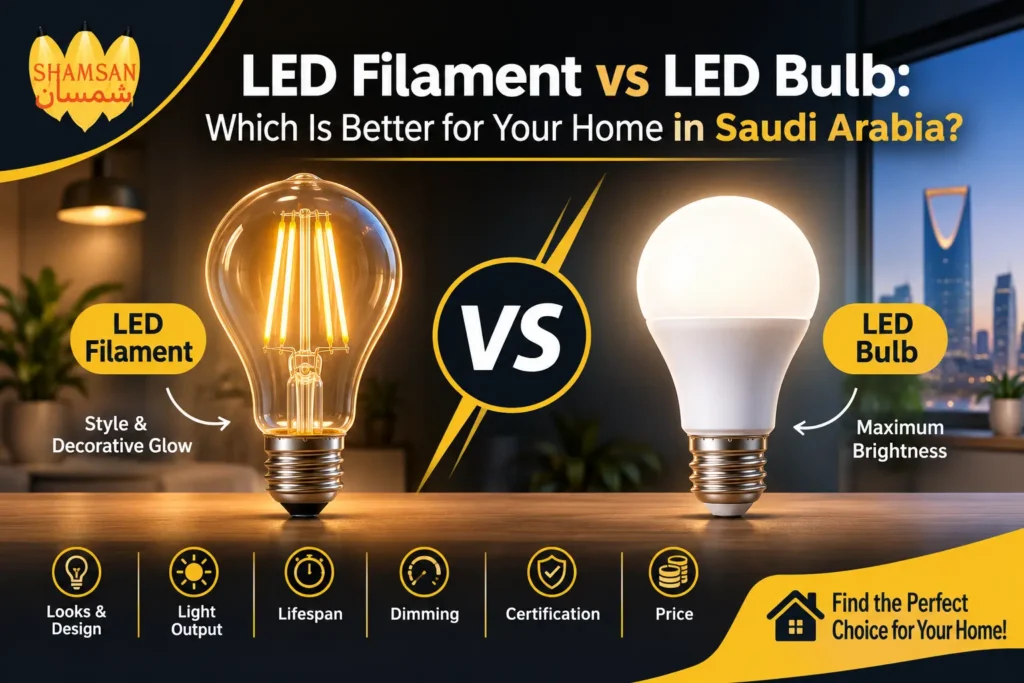
LED filament vs LED bulb comes down to style versus brightness. An E27 warm white LED filament bulb gives a soft, decorative glow, while a standard LED bulb delivers more light for everyday tasks. Choose filament for visible, decorative fixtures. Choose a standard LED for kitchens, offices and garages.
Picking between the two is harder than it looks. Both save energy, both fit the same sockets, and the packaging rarely explains the difference. This guide covers looks, light output, lifespan, dimming, certification and price, so you can decide in a few minutes.
LED Filament vs LED Bulb: What Is the Difference?
Both use LED chips and both save energy. The difference is how the light is built and how it looks.
- LED filament bulb: thin LED strips sit inside a clear or amber glass shell. The bulb looks like a vintage Edison lamp and spreads a warm glow in all directions.
- Standard LED bulb: LED chips sit on a board behind a frosted cover, often with a metal heat sink. It is built to push out as much usable light as possible.
In short, filament bulbs are made to be seen. Standard LED bulbs are made to work in the background.
What Is an LED Filament Lamp?
An LED filament lamp is an LED bulb that uses thin LED strips, called filaments, inside a clear or amber glass shell to mimic a traditional Edison bulb. It gives a warm, 360-degree glow while using far less electricity than incandescent lamps. Most come with an E27 or E14 base.
The U.S. Department of Energy says LED lighting uses at least 75% less energy than incandescent lighting and can last up to 25 times longer (source: energy.gov). That saving applies to filament LEDs too.
Is an LED Filament Bulb Better Than a Regular LED Bulb?
It depends on the job. A filament bulb is better for decorative, visible fixtures because of its warm glow and vintage look. A regular LED bulb is better for bright, functional spaces such as kitchens, offices and garages, since it usually delivers more lumens per bulb and suits enclosed fittings.
When to Choose Filament
- Pendant lights, chandeliers and wall sconces with exposed bulbs
- Living rooms, majlis corners, cafés and boutique shops
- Anywhere you want a calm, welcoming mood
When to Choose a Standard LED
- Kitchens, workshops, garages and stairwells
- Offices and study areas that need bright, even light
- Enclosed fixtures where heat can build up
Side-by-Side Comparison
| Feature | LED Filament Bulb | Standard LED Bulb |
| Look | Vintage, see-through glass | Frosted, modern |
| Light feel | Warm, soft, decorative | Neutral to bright, functional |
| Best use | Exposed, decorative fixtures | Task and general lighting |
| Typical wattage | 2W to 8W | 5W to 20W |
| Energy use vs incandescent | Very low | Very low |
| Typical price | Slightly higher | Usually lower |
4W vs 6W vs 6.5W Filament Bulbs: Wattage, Lumens, Kelvin and Base Compared
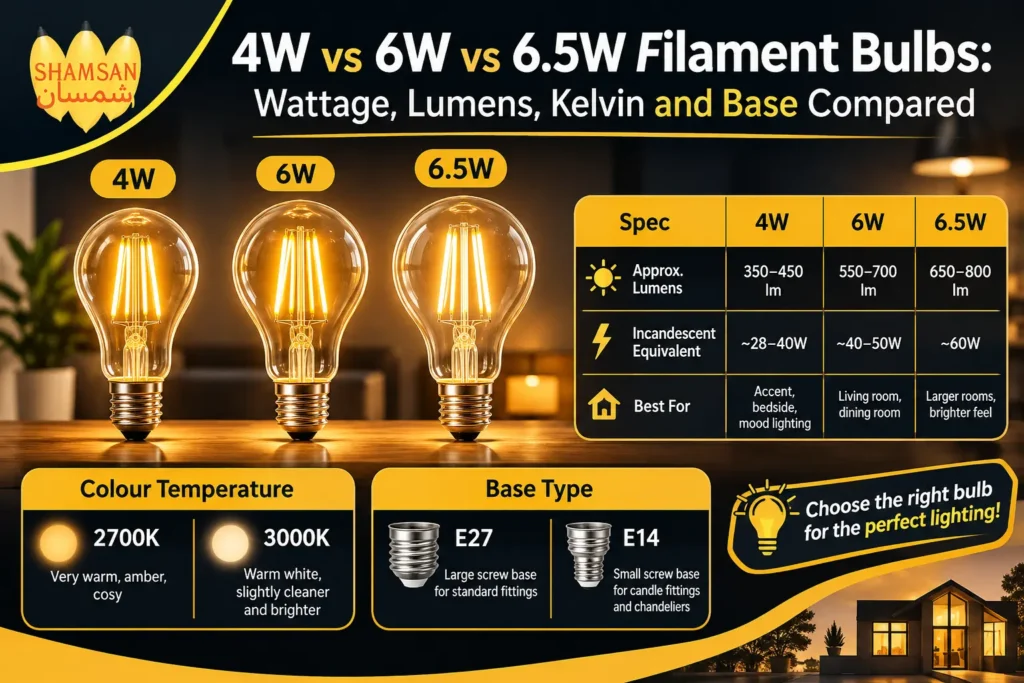
This is the quick reference most buyers need. Lumens are typical ranges, so always confirm the figure printed on the product page or box.
| Spec | 4W | 6W | 6.5W |
| Approx. lumens | 350–450 lm | 550–700 lm | 650–800 lm |
| Incandescent equivalent | ~28–40W | ~40–50W | ~60W |
| Best for | Accent, bedside, mood lighting | Living room, dining room | Larger rooms, brighter feel |
| Choice | Option A | Option B |
| Colour temperature | 2700K: very warm, amber, cosy | 3000K: warm white, slightly cleaner and brighter |
| Base type | E27: large screw base for standard fittings | E14: small screw base for candle fittings and chandeliers |
Shamsan lists 4W, 6W and 6.5W filament lamps on its Filament Lamp page, including an E27 warm white A60 option.
Which E27 filament bulb wattage is best for a living room? For most living rooms, use 4W to 6.5W E27 warm white filament bulbs as ambient lighting, grouped in a multi-bulb fixture. Add a brighter 9W to 12W LED bulb if you need task lighting for reading. A common guide is around 100 to 150 lumens per square meter.
Are Dimmable LED Filament Bulbs Worth It?
Yes, if you want to adjust the mood. A dimmable LED filament bulb lets you lower the light for dinners or evenings and raise it when you need it. But not every filament bulb dims.
Are LED filament bulbs dimmable? Some are, but not all. Many are non-dimmable, so check the packaging for a “dimmable” label. Dimmable versions need a compatible LED dimmer, or they may flicker or buzz. Always match the bulb, dimmer and fixture before installing.
Three tips before you buy:
- Check the box or product page for the word “dimmable.”
- Use a dimmer rated for LED loads, not an old incandescent dimmer.
- Test one bulb first before you buy a full set.
Which Warm White Is Best: 2700K or 3000K?
Both are warm white. 2700K feels like a classic Edison glow and flatters wood, brass and fabric. 3000K is a touch crisper, which suits dining areas and shops. If you can’t decide, use 2700K in bedrooms and living rooms and 3000K where you also read or work. Avoid mixing the two in one room, because the difference becomes obvious.
Are Decorative Edison LED Filament Bulbs Practical?
Yes, if you place them well. A decorative Edison LED filament bulb runs cooler than an old tungsten Edison lamp and uses a fraction of the power. Its limit is brightness: a single 4W bulb will not light a whole room.
- Use three to five bulbs in a cluster pendant for a full-room effect.
- Pick amber glass for a cosy mood and clear glass for a cleaner look.
- Avoid fully enclosed fixtures unless the pack says the bulb is suitable.
What Does Switching Actually Save?
A filament LED draws only a few watts, so running costs are small. A 6W bulb used five hours a day uses roughly 11 kWh a year. A 60W incandescent in the same spot uses about 110 kWh. Filament LEDs also cost little to buy: at the time of writing, Shamsan lists its filament lamps from around SAR 6. Prices change, so check the live listing.
How Do You Check SASO Certification for LED Filament Lamps?
Look for the product’s SASO conformity details, such as a certificate number or a SABER-linked record, before buying in bulk. The Saudi Standards, Metrology and Quality Organization (SASO) sets the rules for electrical products sold in the Kingdom (saso.gov.sa).
If you want a SASO certified LED filament lamp, ask the seller for the certificate or conformity document. A reputable supplier will share it. You can also contact Shamsan on WhatsApp to confirm details for a specific model.
Where Can You Buy LED Filament Bulbs Online in Saudi Arabia?
You can buy LED filament bulbs in Saudi Arabia from Shamsan, a Jeddah-based supplier offering E27 and E14 filament lamps with delivery across the Kingdom, WhatsApp support and a 7-day return policy. Browse the filament category, pick your wattage and base, and check out online.
Here is how to buy with confidence:
- Start at the Shamsan shop or homepage.
- Open Filament Lamps for decorative bulbs, or LED Lamps for A60, A70, A95, candle and corn bulbs.
- Match the base (E27 or E14), wattage and colour temperature.
- Read the product page for lumens and dimming details.
- Check the refund policy, then order.
Shamsan says every lamp is inspected by engineers before shipping. You can read more on the About page.
Expert Tips Before You Buy
- Match the base first. An E27 bulb will not fit an E14 socket.
- Choose lumens, not watts. Lumens tell you how bright the bulb really is.
- Stick to one colour temperature per room.
- Buy a spare. Bulbs from the same batch match best.
- Mix both types. Use filament bulbs for mood and standard LEDs for tasks.
FAQs
Q1: What is an LED filament lamp?
A: An LED filament lamp is an LED bulb that uses thin LED strips, called filaments, inside a clear or amber glass shell to mimic a traditional Edison bulb. It gives a warm, 360-degree glow while using far less electricity than incandescent lamps. Most come with an E27 or E14 base.
Q2: Is an LED filament bulb better than a regular LED bulb?
A: It depends on the job. A filament bulb is better for decorative, visible fixtures because of its warm glow and vintage look. A regular LED bulb is better for bright, functional spaces like kitchens, offices and garages, since it usually delivers more lumens per bulb.
Q3: Are LED filament bulbs dimmable?
A: Some are, but not all. Many are non-dimmable, so check the packaging for a “dimmable” label. Dimmable versions need a compatible LED dimmer, or they may flicker or buzz. Always match the bulb, dimmer and fixture before installing.
Q4: Which E27 filament bulb wattage is best for a living room?
A: For most living rooms, use 4W to 6.5W E27 warm white filament bulbs as ambient lighting, grouped in a multi-bulb fixture. Add a brighter 9W to 12W LED bulb if you need task lighting for reading. A common guide is around 100 to 150 lumens per square meter.
Q5: Where can I buy LED filament bulbs in Saudi Arabia?
A: You can buy LED filament bulbs in Saudi Arabia from Shamsan, a Jeddah-based supplier offering E27 and E14 filament lamps with delivery across the Kingdom, WhatsApp support and a 7-day return policy. Browse the filament category, pick your wattage and base, and check out online.
Q6: Do LED filament bulbs get hot?
A: They run much cooler than incandescent bulbs, though the glass can still feel warm after long use. Avoid tightly enclosed fixtures unless the packaging allows it.
Q7: How long do LED filament bulbs last?
A: Lifespan varies by brand, so check the rated hours on the product page. Heat, voltage spikes and poor ventilation can shorten it.
Conclusion
Choose LED filament when the bulb is visible and the mood matters. Choose a standard LED when you need strong, even light. Most Saudi homes do best with a mix of both. Ready to compare? Explore the Shamsan filament collection or the LED lamp range.